

The global monoclonal antibodies market size is expected to reach around US$ 524.68 billion by 2030 and is expected to grow at an impressive double-digit rate of 12.8% from 2022 to 2030.
The rising cases of cancer and other chronic diseases among the global population is expected to drive the demand for the monoclonal antibodies and foster the market growth during the forecast period.
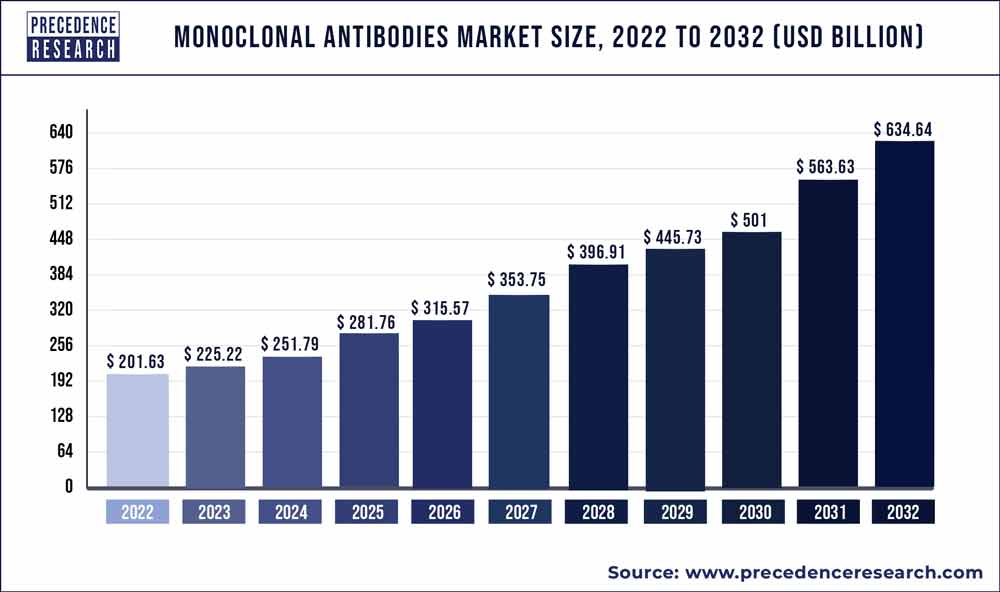
The study includes drivers and restraints of this market. The study provides an analysis of the global monoclonal antibodies market for the period 2017-2030, wherein 2022 to 2030 is the forecast period and 2021 is considered as the base year.
Report Scope of the Monoclonal Antibodies Market
| Report Coverage | Details |
| Market Size by 2030 | USD 524.68 Billion |
| Market Size in 2022 | USD 200.18 Billion |
| CAGR from 2022 to 2030 | CAGR of 12.8% |
| North America Market Share in 2021 | 45% |
| Base Year | 2021 |
| Forecast Period | 2022 to 2030 |
| Segments Covered | Source, Indication, Distribution Channel, Production Methods, Geography |
Our Free Sample Reports Includes:
- In-depth Industry Analysis, Introduction, Overview, and COVID-19 Pandemic Outbreak.
- Impact Analysis 150+ Pages Research Report (Including latest research).
- Provide chapter-wise guidance on request 2022 Updated Regional Analysis with Graphical Representation of Trends, Size, & Share, Includes Updated List of figures and tables.
- Updated Report Includes Major Market Players with their Sales Volume, Business Strategy and Revenue Analysis by using Precedence Research methodology.
Download Free Sample Copy Here (Including TOC, List of Tables & Figures, and Chart) @ https://www.precedenceresearch.com/sample/1735
Research Methodology
A unique research methodology has been utilized to conduct comprehensive research on the growth of the global monoclonal antibodies market and arrive at conclusions on the future growth prospects of the market. This research methodology is a combination of primary and secondary research, which helps analysts warrant the accuracy and reliability of the draw conclusions. Secondary sources referred to by analysts during the production of the global market report include statistics from company annual reports, SEC filings, company websites, World Bank database, investor presentations, regulatory databases, government publications, and industry white papers. Analysts have also interviewed senior managers, product portfolio managers, CEOs, VPs, and market intelligence managers, who contributed to the production of our study on the market as a primary source.
These primary and secondary sources provided exclusive information during interviews, which serves as a validation from mattress topper industry leaders. Access to an extensive internal repository and external proprietary databases allows this report to address specific details and questions about the global monoclonal antibodies market with accuracy. The study also uses the top-down approach to assess the numbers for each segment and the bottom-up approach to counter-validate them. This has helped to estimates the future prospects of the global market more reliable and accurate.
Monoclonal Antibodies Market By Source 2021 ($Million)
| Humanized mAb | 17,125.00 |
| Human mAb | 25,030.00 |
| Murine mAb | 52,900.15 |
| Chimeric mAb | 69,110.00 |
Why should you invest in this report?
If you are aiming to enter the global monoclonal antibodies market, this report is a comprehensive guide that provides crystal clear insights into this niche market. All the major application areas for monoclonal antibodies are covered in this report and information is given on the important regions of the world where this market is likely to boom during the forecast period of 2022-2030, so that you can plan your strategies to enter this market accordingly.
Besides, through this report, you can have a complete grasp of the level of competition you will be facing in this hugely competitive market and if you are an established player in this market already, this report will help you gauge the strategies that your competitors have adopted to stay as market leaders in this market. For new entrants to this market, the voluminous data provided in this report is invaluable.
Some of the prominent players in the global monoclonal antibodies market include:
- Johnson & Johnson
- Merck
- AbbVie
- Amgen
- GlaxoSmithKline plc.
- Norvatis AG
- Pfizer Inc.
- Thermofischer Scientific
- Elililly and Company
- Bristol-Myers Squibb
Market Segmentation:
By Source
- Humanized mAb
- Human mAb
- Murine mAb
- Chimeric mAb
By Indication
- Cancer
- Breast cancer
- Colorectal cancer
- Lung cancer
- Ovarian cancer
- Others
- Autoimmune Diseases
- Inflammatory Diseases
- Infectious Diseases
- Others
By Distribution Channel
- Hospital Pharmacy
- Online Pharmacy
- Retail Pharmacy
By Production Methods
- In Vivo
- In Vitro
Regional Analysis:
The geographical analysis of the global monoclonal antibodies market has been done for North America, Europe, Asia-Pacific, and the Rest of the World.
The North American Market is again segmented into the US, Canada, and Mexico. Coming to the European Market, it can be segmented further into the UK, Germany, France, Italy, Spain, and the rest. Coming to the Asia-Pacific, the global monoclonal antibodies Market is segmented into China, India, Japan, and Rest of Asia Pacific. Among others, the market is segmented into the Middle East and Africa, (GCC, North Africa, South Africa and Rest of the Middle East & Africa).
Key Questions Answered by the Report:
- What will be the size of the global monoclonal antibodies market in 2030?
- What is the expected CAGR for the monoclonal antibodies market between 2021 and 2030?
- Which are the top players active in this global market?
- What are the key drivers of this global market?
- How will the market situation change in the coming years?
- Which region held the highest market share in this global market?
- What are the common business tactics adopted by players?
- What is the growth outlook of the global monoclonal antibodies market?
TABLE OF CONTENT
Chapter 1. Introduction
1.1. Research Objective
1.2. Scope of the Study
1.3. Definition
Chapter 2. Research Methodology
2.1. Research Approach
2.2. Data Sources
2.3. Assumptions & Limitations
Chapter 3. Executive Summary
3.1. Market Snapshot
Chapter 4. Market Variables and Scope
4.1. Introduction
4.2. Market Classification and Scope
4.3. Industry Value Chain Analysis
4.3.1. Raw Material Procurement Analysis
4.3.2. Sales and Distribution Channel Analysis
4.3.3. Downstream Buyer Analysis
Chapter 5. COVID 19 Impact on Monoclonal Antibodies Market
5.1. COVID-19 Landscape: Monoclonal Antibodies Industry Impact
5.2. COVID 19 - Impact Assessment for the Industry
5.3. COVID 19 Impact: Global Major Government Policy
5.4. Market Trends and Opportunities in the COVID-19 Landscape
Chapter 6. Market Dynamics Analysis and Trends
6.1. Market Dynamics
6.1.1. Market Drivers
6.1.2. Market Restraints
6.1.3. Market Opportunities
6.2. Porter’s Five Forces Analysis
6.2.1. Bargaining power of suppliers
6.2.2. Bargaining power of buyers
6.2.3. Threat of substitute
6.2.4. Threat of new entrants
6.2.5. Degree of competition
Chapter 7. Competitive Landscape
7.1.1. Company Market Share/Positioning Analysis
7.1.2. Key Strategies Adopted by Players
7.1.3. Vendor Landscape
7.1.3.1. List of Suppliers
7.1.3.2. List of Buyers
Chapter 8. Global Monoclonal Antibodies Market, By Source
8.1. Monoclonal Antibodies Market, by Source, 2022-2030
8.1.1. Humanized mAb
8.1.1.1. Market Revenue and Forecast (2017-2030)
8.1.2. Human mAb
8.1.2.1. Market Revenue and Forecast (2017-2030)
8.1.3. Murine mAb
8.1.3.1. Market Revenue and Forecast (2017-2030)
8.1.4. Chimeric mAb
8.1.5.1. Market Revenue and Forecast (2017-2030)
Chapter 9. Global Monoclonal Antibodies Market, By Indication
9.1. Ambulatory Surgical Center Market, by Indication e, 2022-2030
9.1.1. Cancer
9.1.1.1. Market Revenue and Forecast (2017-2030)
9.1.2. Autoimmune Diseases
9.1.2.1. Market Revenue and Forecast (2017-2030)
9.1.3. Inflammatory Diseases
9.1.3.1. Market Revenue and Forecast (2017-2030)
9.1.4. Infectious Diseases
9.1.4.1. Market Revenue and Forecast (2017-2030)
9.1.5. Others
9.1.5.1. Market Revenue and Forecast (2017-2030)
Chapter 10. Global Monoclonal Antibodies Market, By Distribution Channel
10.1. Monoclonal Antibodies Market, by Distribution Channel, 2022-2030
10.1.1. Hospital Pharmacy
10.1.1.1. Market Revenue and Forecast (2017-2030)
10.1.2. Online Pharmacy
10.1.2.1. Market Revenue and Forecast (2017-2030)
10.1.3. Retail Pharmacy
10.1.3.1. Market Revenue and Forecast (2017-2030)
Chapter 11. Global Monoclonal Antibodies Market, By Production Methods
11.1. Monoclonal Antibodies Market, by Production Methods, 2022-2030
11.1.1. In Vivo
11.1.1.1. Market Revenue and Forecast (2017-2030)
11.1.2. In Vitro
11.1.2.1. Market Revenue and Forecast (2017-2030)
Chapter 12. Global Monoclonal Antibodies Market, Regional Estimates and Trend Forecast
12.1. North America
12.1.1. Market Revenue and Forecast, by Source (2017-2030)
12.1.2. Market Revenue and Forecast, by Indication (2017-2030)
12.1.3. Market Revenue and Forecast, by Distribution Channel (2017-2030)
12.1.4. Market Revenue and Forecast, by Production Methods (2017-2030)
12.1.5. U.S.
12.1.5.1. Market Revenue and Forecast, by Source (2017-2030)
12.1.5.2. Market Revenue and Forecast, by Indication (2017-2030)
12.1.5.3. Market Revenue and Forecast, by Distribution Channel (2017-2030)
12.1.5.4. Market Revenue and Forecast, by Production Methods (2017-2030)
12.1.6. Rest of North America
12.1.6.1. Market Revenue and Forecast, by Source (2017-2030)
12.1.6.2. Market Revenue and Forecast, by Indication (2017-2030)
12.1.6.3. Market Revenue and Forecast, by Distribution Channel (2017-2030)
12.1.6.4. Market Revenue and Forecast, by Production Methods (2017-2030)
12.2. Europe
12.2.1. Market Revenue and Forecast, by Source (2017-2030)
12.2.2. Market Revenue and Forecast, by Indication (2017-2030)
12.2.3. Market Revenue and Forecast, by Distribution Channel (2017-2030)
12.2.4. Market Revenue and Forecast, by Production Methods (2017-2030)
12.2.5. UK
12.2.5.1. Market Revenue and Forecast, by Source (2017-2030)
12.2.5.2. Market Revenue and Forecast, by Indication (2017-2030)
12.2.5.3. Market Revenue and Forecast, by Distribution Channel (2017-2030)
12.2.5.4. Market Revenue and Forecast, by Production Methods (2017-2030)
12.2.6. Germany
12.2.6.1. Market Revenue and Forecast, by Source (2017-2030)
12.2.6.2. Market Revenue and Forecast, by Indication (2017-2030)
12.2.6.3. Market Revenue and Forecast, by Distribution Channel (2017-2030)
12.2.6.4. Market Revenue and Forecast, by Production Methods (2017-2030)
12.2.7. France
12.2.7.1. Market Revenue and Forecast, by Source (2017-2030)
12.2.7.2. Market Revenue and Forecast, by Indication (2017-2030)
12.2.7.3. Market Revenue and Forecast, by Distribution Channel (2017-2030)
12.2.7.4. Market Revenue and Forecast, by Production Methods (2017-2030)
12.2.8. Rest of Europe
12.2.8.1. Market Revenue and Forecast, by Source (2017-2030)
12.2.8.2. Market Revenue and Forecast, by Indication (2017-2030)
12.2.8.3. Market Revenue and Forecast, by Distribution Channel (2017-2030)
12.2.8.4. Market Revenue and Forecast, by Production Methods (2017-2030)
12.3. APAC
12.3.1. Market Revenue and Forecast, by Source (2017-2030)
12.3.2. Market Revenue and Forecast, by Indication (2017-2030)
12.3.3. Market Revenue and Forecast, by Distribution Channel (2017-2030)
12.3.4. Market Revenue and Forecast, by Production Methods (2017-2030)
12.3.5. India
12.3.5.1. Market Revenue and Forecast, by Source (2017-2030)
12.3.5.2. Market Revenue and Forecast, by Indication (2017-2030)
12.3.5.3. Market Revenue and Forecast, by Distribution Channel (2017-2030)
12.3.5.4. Market Revenue and Forecast, by Production Methods (2017-2030)
12.3.6. China
12.3.6.1. Market Revenue and Forecast, by Source (2017-2030)
12.3.6.2. Market Revenue and Forecast, by Indication (2017-2030)
12.3.6.3. Market Revenue and Forecast, by Distribution Channel (2017-2030)
12.3.6.4. Market Revenue and Forecast, by Production Methods (2017-2030)
12.3.7. Japan
12.3.7.1. Market Revenue and Forecast, by Source (2017-2030)
12.3.7.2. Market Revenue and Forecast, by Indication (2017-2030)
12.3.7.3. Market Revenue and Forecast, by Distribution Channel (2017-2030)
12.3.7.4. Market Revenue and Forecast, by Production Methods (2017-2030)
12.3.8. Rest of APAC
12.3.8.1. Market Revenue and Forecast, by Source (2017-2030)
12.3.8.2. Market Revenue and Forecast, by Indication (2017-2030)
12.3.8.3. Market Revenue and Forecast, by Distribution Channel (2017-2030)
12.3.8.4. Market Revenue and Forecast, by Production Methods (2017-2030)
12.4. MEA
12.4.1. Market Revenue and Forecast, by Source (2017-2030)
12.4.2. Market Revenue and Forecast, by Indication (2017-2030)
12.4.3. Market Revenue and Forecast, by Distribution Channel (2017-2030)
12.4.4. Market Revenue and Forecast, by Production Methods (2017-2030)
12.4.5. GCC
12.4.5.1. Market Revenue and Forecast, by Source (2017-2030)
12.4.5.2. Market Revenue and Forecast, by Indication (2017-2030)
12.4.5.3. Market Revenue and Forecast, by Distribution Channel (2017-2030)
12.4.5.4. Market Revenue and Forecast, by Production Methods (2017-2030)
12.4.6. North Africa
12.4.6.1. Market Revenue and Forecast, by Source (2017-2030)
12.4.6.2. Market Revenue and Forecast, by Indication (2017-2030)
12.4.6.3. Market Revenue and Forecast, by Distribution Channel (2017-2030)
12.4.6.4. Market Revenue and Forecast, by Production Methods (2017-2030)
12.4.7. South Africa
12.4.7.1. Market Revenue and Forecast, by Source (2017-2030)
12.4.7.2. Market Revenue and Forecast, by Indication (2017-2030)
12.4.7.3. Market Revenue and Forecast, by Distribution Channel (2017-2030)
12.4.7.4. Market Revenue and Forecast, by Production Methods (2017-2030)
12.4.8. Rest of MEA
12.4.8.1. Market Revenue and Forecast, by Source (2017-2030)
12.4.8.2. Market Revenue and Forecast, by Indication (2017-2030)
12.4.8.3. Market Revenue and Forecast, by Distribution Channel (2017-2030)
12.4.8.4. Market Revenue and Forecast, by Production Methods (2017-2030)
12.5. Latin America
12.5.1. Market Revenue and Forecast, by Source (2017-2030)
12.5.2. Market Revenue and Forecast, by Indication (2017-2030)
12.5.3. Market Revenue and Forecast, by Distribution Channel (2017-2030)
12.5.4. Market Revenue and Forecast, by Production Methods (2017-2030)
12.5.5. Brazil
12.5.5.1. Market Revenue and Forecast, by Source (2017-2030)
12.5.5.2. Market Revenue and Forecast, by Indication (2017-2030)
12.5.5.3. Market Revenue and Forecast, by Distribution Channel (2017-2030)
12.5.5.4. Market Revenue and Forecast, by Production Methods (2017-2030)
12.5.6. Rest of LATAM
12.5.6.1. Market Revenue and Forecast, by Source (2017-2030)
12.5.6.2. Market Revenue and Forecast, by Indication (2017-2030)
12.5.6.3. Market Revenue and Forecast, by Distribution Channel (2017-2030)
12.5.6.4. Market Revenue and Forecast, by Production Methods (2017-2030)
Chapter 13. Company Profiles
13.1. Johnson & Johnson
13.1.1. Company Overview
13.1.2. Product Offerings
13.1.3. Financial Performance
13.1.4. Recent Initiatives
13.2. Merck
13.2.1. Company Overview
13.2.2. Product Offerings
13.2.3. Financial Performance
13.2.4. Recent Initiatives
13.3. AbbVie
13.3.1. Company Overview
13.3.2. Product Offerings
13.3.3. Financial Performance
13.3.4. Recent Initiatives
13.4. Amgen
13.4.1. Company Overview
13.4.2. Product Offerings
13.4.3. Financial Performance
13.4.4. Recent Initiatives
13.5. GlaxoSmithKline plc.
13.5.1. Company Overview
13.5.2. Product Offerings
13.5.3. Financial Performance
13.5.4. Recent Initiatives
13.6. Norvatis AG
13.6.1. Company Overview
13.6.2. Product Offerings
13.6.3. Financial Performance
13.6.4. Recent Initiatives
13.7. Pfizer Inc.
13.7.1. Company Overview
13.7.2. Product Offerings
13.7.3. Financial Performance
13.7.4. Recent Initiatives
13.8. Thermofischer Scientific
13.8.1. Company Overview
13.8.2. Product Offerings
13.8.3. Financial Performance
13.8.4. Recent Initiatives
13.9. Elililly and Company
13.9.1. Company Overview
13.9.2. Product Offerings
13.9.3. Financial Performance
13.9.4. Recent Initiatives
13.10. Bristol-Myers Squibb
13.10.1. Company Overview
13.10.2. Product Offerings
13.10.3. Financial Performance
13.10.4. Recent Initiatives
Chapter 14. Research Methodology
14.1. Primary Research
14.2. Secondary Research
14.3. Assumptions
Chapter 15. Appendix
15.1. About Us
15.2. Glossary of Terms
Contact Us:
Mr. Alex
Sales Manager
Call: +1 9197 992 333
Email: sales@precedenceresearch.com


0 Comments